
|
|
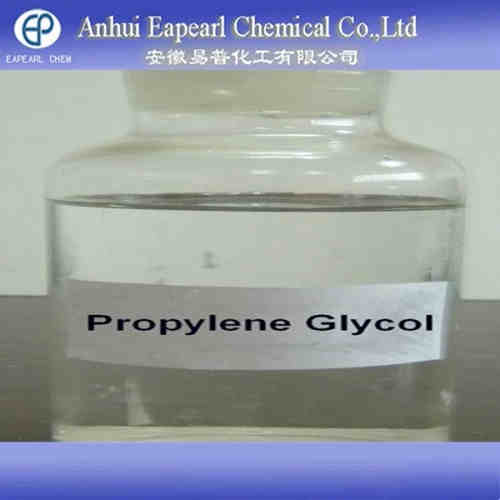
Propylene glycol is scientifically named as “1,2-propanediol”, and has a chemical formula of CH3CHOHCH2OH and a molecular weight of 76.10. There is a chiral carbon atom in the molecule. Its racemate is a hygroscopic viscous liquid and is slightly spicy. It has a specific gravity of 1.036 (25/4 °C), a freezing point of-59 °C, and a boiling point of 188.2 °C, respectively 83.2 °C (1,333 Pa). It is miscible with water, acetone, ethyl acetate and chloroform, and is soluble in ether. It is soluble in many essential oils, but is not miscible with petroleum ether and paraffin oil. It is relatively stable to heat and light, and is more stable at low temperatures. Its L-isomer has a boiling point of 187 to 189 °C and a specific optical rotation [α] of D20-15.0°. It can be oxidized at high temperatures to propionaldehyde, lactic acid, pyruvic acid and acetic acid. |
| Medicinal property and application | Propylene glycol has good solubility and less toxicity and irritation, and is widely used as solvents, extraction solvents and preservatives for injections (eg. intramuscular injections, intravenous injections) and non-injectable pharmaceutical preparations (such as oral liquid, ophthalmic preparations, otic preparations, dental preparations, rectovaginal preparations, transdermal preparations, etc.). It is better than glycerol solvent and can dissolve many substances such as corticosteroids (sex hormone), chloramphenicol, sulfonamides, reserpine, quinidine, corticosterone acetate, tetrahydropalmatine sulfate, mechlorethamine hydrochloride, vitamin A, vitamin D, many volatile oils, most of the alkaloids and many local anesthetics. Propylene glycol is similar to ethanol when used as a bacteriostatic agent, and its efficacy to inhibit mold is similar to glycerin and is slightly lower than that of ethanol. Propylene glycol is commonly used as a plasticizer for the aqueous film coating materials. Its mixture with equal amounts of water can delay the hydrolysis of certain drugs, and increase the stability of the preparation product. It is used as an antimicrobial preservative in 15% to 30% propylene glycol solution and semi-solid formulation, as humectants in about 15% propylene glycol topical formulation, and as solvent and co-solvent in 10% to 30% propylene glycol aerosol solvent, 10% to 25 % propylene glycol oral solution, 10% to 60% injectable formulation and 5% to 80% topical formulation. [Stability and storage condition] It is very stable at room temperature, but is oxidized when left open at high temperatures (above 280 °C); has a chemical stability after mixing with 95% ethanol or water; can be sterilized by autoclaving or sterile filtration. Propylene glycol has hygroscopicity, and should be positioned at cool and dry place and stored in dark airtight container. [Incompatibility] It has incompatibility with some oxidants (such as potassium permanganate). |
| Uses | 1. It is used as a resin, a plasticizer, a surfactant, and materials for emulsifier and demulsifier. It is also used as antifreeze and heat carrier. 2. It is used as gas chromatography stationary phase, solvents, antifreeze, a plasticizer and a dehydrating agent. 3. A carrier solvent; wetting agents; moisturizing agents; anti-caking agents; antioxidants; texturizing agents; surfactant; stabilizer; a thickener; dough modifiers; emulsifiers; flavoring agents; excipient; processing aids.GB2760-96 lists it as food processing aids. It is mainly used as solvents for a variety of flavors, colors and preservatives, and as extraction solvents for vanilla beans, roasted coffee grains and natural spices. It is used as moisturizing agents and softeners for candy, bread, packaged meats and cheese. It is also used as mildew agents for noodles and sandwiches class. Addition of 0.006% in soymilk enables the flavor not to change upon heating and produces white glossy packaging tofu, which undergoes volume expansion when fried. 4. Propylene glycol is an intermediate for fungicide difenoconazole. 5. It is used a solvent. Preservatives, colorings, antioxidants and other poorly water-soluble food additives can be dissolved therein, which is then added into food; it is strongly hygroscopic and has food moisturizing and anti-freeze effect. China stipulates its use for pastry, and the maximum usage is 3.0g/kg. 6. Propylene glycol is an important raw material for unsaturated polyester, epoxy resin, and polyurethane resin. The use amount in this area accounts for about 45% of the total consumption of propylene glycol. Such unsaturated polyester is used extensively for reinforced plastics and surface coatings. Propylene glycol is excellent in viscosity and hygroscopicity and is non-toxic, and thus is widely used as hygroscopic agent, antifreeze, lubricants and solvents in the food, pharmaceutical and cosmetic industry. In the food industry, propylene glycol reacts with fatty acid to give propylene ester of fatty acids, and is mainly used as food emulsifier; Propylene glycol is a good solvent for flavorings and pigments. Propylene glycol is commonly used as solvents, softeners and excipients, etc. in the pharmaceutical industry for the manufacture of various types of ointments and salves. Propylene glycol is also used as a solvent and a softener for cosmetic since it has good mutual solubility with various spices. Propylene glycol is also used as tobacco moisturizing agents, antifungal agents, food processing equipment lubricants and solvents for food marking ink. Aqueous solution of propylene glycol is an effective anti-freeze agent. 7. It is used as a drug carrier, and agents for drug particles. It can be used as humectants, softeners, solvents and the like in cosmetics. It can be used as tobacco flavor, tobacco moisturizing agents, preservatives and the like in the tobacco industry. It can be used as flavor, food coloring solvents, food packaging softeners, food release agent and the like in food industry. It can also be used for the production of unsaturated polyester resins, and is also raw materials for plasticizers, dehydrating agents, surfactants, curing agents and binders. It can also be used in paints, pesticides, coatings and other industries. 8. It is used in aviation de-icing fluid, refrigerant and antifreeze, food and spices, fragrances, cosmetics and personal care products, heat transfer fluids, hydraulic and brake fluids, paints and coatings, pet food/animal feeding stuffs, medicines, polyurethane, unsaturated polyester resin and the like. |

ZLAB Capsule Fil $ 1.00
3 ply disposabl $ 1.00

CHY-H1210 Compa $ 0.00

CHY-J1220 Labor $ 0.00
CHY-M1516 High $ 0.00
| Comment | ||
| Comment on the content: | ||
| Enter verification code: |
|
|